Study Japanese in Japan, with a teacher on your side.
I'm a native Japanese teacher based in Osaka, and I work with English speakers every day. I'll check your level myself, find a language school in Japan that fits your goal, in whichever city suits you, talk to the school in Japanese for you, and stay in touch after you land. Free for you: no fees, ever. Schools pay me, you don't.
Osaka, JapanI live here. You can meet me in person after you land.
Native JapaneseI deal with the school in Japanese, so nothing gets lost.
20+countries my students come from
Choosing a school from abroad is hard.
Most school websites are in Japanese, and the brochures all say the same things: small classes, friendly teachers, JLPT preparation (the Japanese Language Proficiency Test, from N5 for beginners to N1 for advanced). From the outside, you can't tell which course would actually suit you.
That's the part a teacher can help with. I'll ask what you can say in Japanese right now, what you want to be able to do, and how long you have. Then I'll tell you which schools match, and which don't.
I teach Japanese online to English speakers, and I run @helpmekansai, an Instagram account about the difference between standard Japanese and the Kansai dialect (the everyday Japanese of Osaka, Kyoto, Kobe and the wider Kansai region, spoken by around 20 million people). Most readers live outside Japan, and many have asked me the question you might have: "Where should I study?"
Why not just use a big agency?
You can, and for some people that's the right call. This is the honest difference.
How KOTOHA compares with a large study-abroad placement agency
A large placement agency
KOTOHA
Who you talk to
A coordinator, often a former student. Next time it may be someone else.
A native Japanese teacher, living in Osaka. The same person every time.
Who checks your level
Usually a form.
Me, on a 30-minute call. I do this every day.
Which schools
Their partner schools only.
The school that fits, including ones that don't pay me. I'll say so.
Where
Nationwide, usually run from Tokyo.
Anywhere in Japan. I'm based in Osaka, so Kansai is where I know best and where you can meet me in person, but Tokyo, Fukuoka or Sapporo are all fine. We pick the city for your goal, not mine.
After you land
Depends on the package.
Message me any day. Plus a free language meetup in Osaka, and in Vancouver when you go home.
Cost to you
Usually free.
¥0. No sign-up fee, no success fee, no hidden extras. Always.
Size
Thousands of students a year.
Small on purpose, so I can actually stay in touch.
What the big agencies have that I don't: fifteen years of history, thousands of reviews, and staff in seven languages. I'm one teacher, working in English and Japanese, and I started this in 2026. If that matters more to you than the table above, a big agency is a good choice. I'd still be happy to answer a question.
Is this for you?
Three situations I hear most often. You don't have to fit neatly into one.
1 to 3 months
"I want to try living in Japan first."
A short course while you travel. For many nationalities no visa is needed for stays up to 90 days. Good for testing whether you like a city, a school, and daily life in Japanese before committing to a year.
About 1 year
"I want to get properly good at Japanese."
A long-term course on a student visa. Full-time classes, usually 4 start dates a year (January, April, July and October). The school applies for your visa paperwork, and I help you prepare for it. This is the route if you're aiming for JLPT N2 (upper-intermediate) or work in Japan.
Not sure yet
"I don't know what's realistic."
That's fine. Tell me what you can say in Japanese now and what you'd like to be able to do. We work backwards from there. Sometimes the honest answer is "study online for six more months, then come."
How it works
Four steps. Nothing is binding until you apply to a school yourself.
Book a call, or send a question
Pick a time on my calendar, or use the form at the bottom of this page. Tell me roughly where you are with Japanese and when you'd like to come.
Free
We talk online
About 30 minutes on a video call, in English. Level check, your goal, your budget, how long you can stay, and what you want daily life to look like.
A few schools that actually fit, with what makes each one different: class style, city, housing, real total cost. I'll set up a call or a visit with the school if you want one.
Free
You apply to the school
I walk you through the school's process and answer questions along the way. You pay the school directly. I never handle your money.
Free
What I check before a school goes on your list
Every school says "small classes and friendly teachers". These are the things I actually look at.
Class size and level splitHow many levels the school runs, so you're not stuck in a class that's too easy or too hard for you.
Who's in the roomThe nationality mix, and how many classmates you could fall back on English with. Fewer is better for your Japanese.
Immigration standingWhether the school has the immigration bureau's "properly managed school" status (適正校, tekisei-kō). It makes your visa paperwork lighter.
The real totalTuition plus enrolment, materials, insurance and housing fees, in one number. Brochures rarely show it that way.
Start dates and deadlinesMost schools have 4 intakes a year, and the application deadline is months earlier. I'll tell you which one is realistic for you.
English-speaking staffSomeone at the school who can help you in English on a bad day. Not every school has this.
HousingDormitory, share house (a shared apartment with private rooms) or homestay, how far from school, and what it really costs.
Where students go nextJLPT results, university places and jobs, where the school publishes them.
What it costs
My part is free. Here is roughly what the school and living costs look like.
KOTOHA's counselling and introductions: ¥0 for you
You pay nothing to me. Not for the call, not for the shortlist, not for the introduction.
Schools pay me a referral fee when a student I introduced enrols. This is a normal arrangement in Japan and it does not change your tuition.
I don't work exclusively for any school, and I don't recommend a school because it pays more. If a school I have no arrangement with is the right fit, I'll tell you.
You pay the school directly. Tuition and fees go from you to the school. I am never in the middle of that.
Rough guide to school and living costs
Approximate costs of studying at a Japanese language school
Typical range
Short course, per week
¥30,000 to ¥50,000
3-month full-time course
¥150,000 to ¥200,000
1-year course, tuition
¥600,000 to ¥900,000
School dormitory, per month
¥30,000 to ¥50,000
Living costs, per month
¥100,000 to ¥180,000
These are rough ranges from published school fees, not quotes. Schools differ a lot, and the city matters: Tokyo sits at the top of the living-cost range, Osaka, Fukuoka and smaller cities nearer the bottom. When I shortlist schools for you, I'll give you each school's exact figures.
Visa and timing
The basics, so you know what to expect. The school handles the official paperwork.
Up to 90 days: usually no visa
Citizens of Canada, the US, the UK, Australia, New Zealand, and most of Europe can enter Japan as a temporary visitor for up to 90 days without applying for a visa in advance. You can take a short language course on that status. You can't work.
When to start: 1 to 2 months before you want to arrive is usually enough. Popular months fill up, so earlier is better.
Longer than 90 days: student visa
You need a student visa. The school applies for a Certificate of Eligibility (a document from Japanese immigration that says you can be issued a student visa) on your behalf, then you get the visa at a Japanese embassy or consulate in your country. You'll need to show that you or your family can cover tuition and living costs. With permission, students can work part-time up to 28 hours a week.
When to start: 6 to 9 months before the start date you want. Most schools start in January, April, July and October, and applications close a few months earlier.
One thing I don't do: I don't prepare or write your financial documents. You and your family prepare them, and they go to the school as they are. This keeps the process honest for you, for the school, and for me.
Where to study
Any city in Japan. I'm based in Osaka, so that's where I know the most, but the right city is the one that fits your goal.
TOKYO
The widest choice of schools
More schools, more course types, and the most part-time jobs. Rent is the highest in Japan, and it's easy to get by in English, which can slow your Japanese down. Good if your goal is work in Tokyo or a specific school there.
OSAKA · KYOTO · KOBE
Where I live, and cheaper than Tokyo
Three cities 30 minutes apart: Osaka's food and talkative people, Kyoto's temples, Kobe's sea and mountains. I was born in Osaka, so here you can meet me in person, and the free language meetup is here.
FUKUOKA · SAPPORO · ELSEWHERE
Smaller city, more Japanese every day
Fewer English speakers around you, lower rent, and classes that are often smaller. Fukuoka, Sapporo, Nagoya, Hiroshima, Okinawa. If a city like this fits your goal, I'll find the schools there and check them the same way.
You won't land alone.
Most agencies stop at the airport. I think that's where the real work starts.
Canadays language exchange, Vancouver. Free for KOTOHA students when you go home.
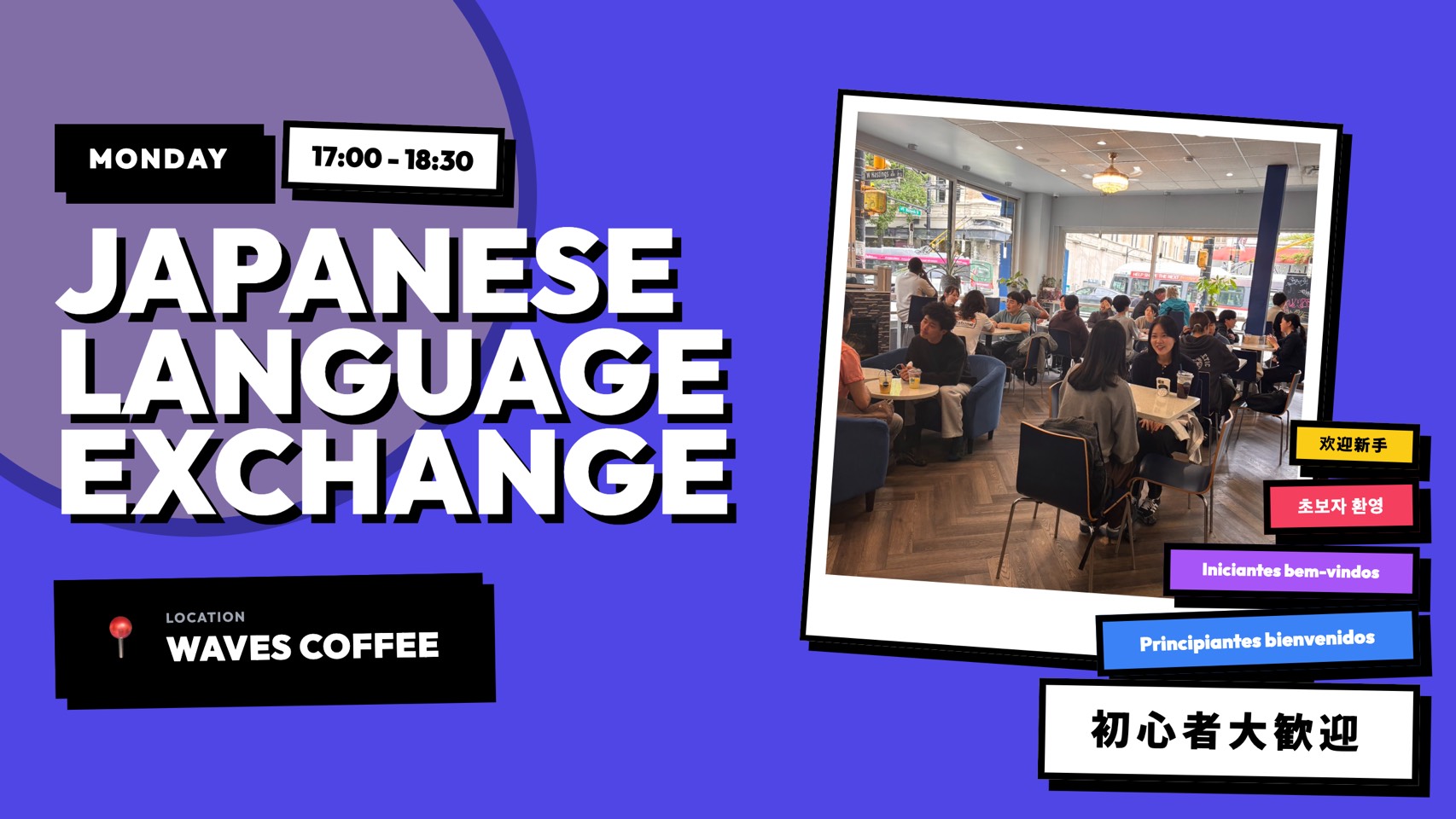
Japanese people who want to practise English, learners who want to practise Japanese, in the same room. Use what you learned in class the same week. Free for students I introduced, on short and long courses alike. Studying in another city? I'll point you to a good exchange there.
When you go home
Keep speaking Japanese in Vancouver
Canadays, our partner community in Vancouver, runs Japanese–English language exchanges five times a week, with 700+ people a month. As an KOTOHA student you join free after you return. Your Japanese doesn't have to stop at the airport.
Any day
Message me
A form you don't understand, a landlord, something a teacher said. Send it to me. I'll help you sort it out, and if the school should know, I'll pass it on with your permission.
Questions people ask me
Is it really free?
Yes. You don't pay me anything at any point. When a student I introduced enrols, the school pays me a referral fee. That fee comes out of the school's marketing budget, not out of your tuition. If you ever feel a cost is unclear, ask me directly and I'll show you exactly who pays what.
Do you only work with certain schools?
No. I have referral arrangements with some schools and none with others. If the right school for you is one that doesn't pay me, I'll tell you, and you can apply to them directly. I'd rather you end up in the right place than in a school that pays me.
You're one person. What if you're busy?
Fair question. I keep the number of students I work with at any one time small, and you'll always have a direct way to reach me. If I can't do something well, I'll say so rather than let you wait.
I'm already talking to another agency. Can I still ask you?
Yes. A second opinion costs nothing. I won't contact any school on your behalf unless you ask me to.
Do I need to speak Japanese already?
No. Schools have beginner classes, and our conversations are in English. If you already know some Japanese, tell me roughly what you can do and we'll find a class at the right level rather than starting you from zero.
What if you suggest a school and I don't like it?
Then we look at others. The shortlist is a starting point, not a decision. You can also visit or video-call the school before applying. Nothing is committed until you send an application yourself.
Can I work while I study?
On a student visa, yes, up to 28 hours a week once you get work permission after arriving. On a 90-day temporary visitor stay, no. Many students on the long course do part-time work in cafés, convenience stores or hotels.
Do you help with housing?
I'll tell you what each school offers (dormitory, share house, homestay) and what the neighbourhood is like. Housing contracts are between you and the school or the housing company. I can help you understand the paperwork in English.
Are you an official agent?
I'm an independent Japanese teacher based in Osaka, working on my own under the name KOTOHA. Introductions to schools are referral arrangements. I'm not an immigration lawyer or a visa agency, so for visa questions beyond the basics I'll point you to the school or the official source.
The next step
Book a free 30-minute call
We talk online, in English. Tell me your goal, and I'll tell you honestly which schools fit you — and which ones don't.